Company power of attorney: the UK officer's practical guide
By Jeremy Arhab, Founder · Published 14 August 2026 · Updated 14 August 2026
Discover how to effectively manage a company power of attorney in the UK, ensuring proper execution and compliance for all your legal needs.

A company power of attorney is a formal legal instrument by which a company authorises a named person, the attorney, to sign documents and act on its behalf within defined limits. The single most important formal requirement: where the attorney will execute deeds, the instrument itself must be executed as a deed in the company's name under the Companies Act 2006. A board resolution alone does not create an effective power of attorney for deed execution purposes.
Before the instrument leaves the boardroom, four things must be in place:
- Board authorisation recorded in signed minutes, with the decision rationale and any conflicts noted.
- Correct execution as a deed, using two authorised signatories, one director plus a witness, or the company's common seal.
- Evidence pack for counterparties: an original or certified copy of the deed plus the authorising board resolution.
- A central register of all active powers of attorney, with expiry dates and revocation status clearly recorded.
Pro Tip: Prepare the evidence pack at the same time as the deed. Banks and land registries will ask for it immediately, and having it ready prevents completion delays.
Key takeaways
A company power of attorney must be executed as a deed under the Companies Act 2006, supported by a board resolution, and evidenced by a certified copy pack before any counterparty will rely on it.
| Point | Details |
|---|---|
| Deed execution is mandatory | Where the attorney will sign deeds, the POA instrument must itself be executed as a deed in the company's name. |
| Board authority comes first | A board resolution recording scope, attorney identity and revocation rights must precede execution. |
| Evidence pack for counterparties | Supply the original or certified copy of the deed plus the board resolution proactively to avoid completion delays. |
| Draft scope narrowly | Specify document types, territory, counterparties and a monetary cap; prohibit sub-delegation unless expressly permitted. |
| My Notary for certification | My Notary provides remote notarisation, certified copies and apostille procurement with an average one-hour turnaround. |
Table of Contents
- What is a company power of attorney under UK law?
- What types of company POA suit different business needs?
- Who must authorise a company POA and what approvals are needed?
- How do you execute a company POA so it is legally effective?
- How should you draft the scope, limits and revocation clauses?
- What board minutes and records should accompany the POA?
- How do attorneys sign, and how do third parties verify authority?
- When do you need notarisation and apostille for a company POA used overseas?
- What do company POAs typically cost and how long does the process take?
- What risks do directors face when delegating authority by POA?
- Step-by-step checklist and essential sample wording
- When should you seek legal advice and what should you do this week?
- A practitioner's perspective on what actually goes wrong
- How My Notary simplifies notarisation and certification for company POAs
- Sources
- FAQ
What is a company power of attorney under UK law?
A company power of attorney is a deed executed in the company's name that grants a named individual or entity authority to act on the company's behalf. It is distinct from a personal Lasting Power of Attorney, which is a statutory instrument registered with the Office of the Public Guardian and designed for individuals who may lose mental capacity. A corporate POA has no registration requirement of that kind; its legal effect flows from correct execution and delivery.
The statutory basis in England and Wales and Northern Ireland is clear. Under the Companies Act 2006, a company may, by an instrument executed as a deed, empower a person to execute deeds or other documents on its behalf, and a deed so executed has effect as if executed by the company itself. That last point matters enormously in practice: the attorney's signature on a deed carries the same legal weight as the company's own execution, provided the formalities are met.
The distinction between deeds and simple contracts is worth keeping in mind. A deed executed by an attorney takes effect as if executed by the company; simple contracts, by contrast, can be entered by anyone with the company's express or implied authority, without the deed formality. The POA route is therefore most critical when the transaction requires a deed: property transfers, long leases, certain guarantees and security documents.
What types of company POA suit different business needs?
Commercial practice notes confirm that companies use powers of attorney for property completions, banking mandates, overseas closings, high-volume routine contracts, group company signings and emergency continuity planning. The right form depends on how broad the authority needs to be.
General POA. Grants authority across a wide range of acts and document types. Useful for a group treasury function or a senior officer covering all company business during a director's extended absence. The breadth that makes it convenient also makes it riskier; robust reporting and countersignature controls are essential.
Specific (transaction-limited) POA. Restricts authority to a named transaction, a defined class of documents, a particular territory or a monetary threshold. A limited power of attorney of this kind is the preferred form for most commercial closings: it gives counterparties a clear picture of what the attorney can and cannot do, and it limits the company's exposure if the instrument is misused.
Joint and joint-and-several appointments. Where two attorneys are appointed jointly, both must act together. Joint-and-several appointments allow each to act independently. Joint appointments add a check; joint-and-several appointments add speed. Choose based on the risk profile of the transaction.
A POA is the right tool when a director or authorised signatory is unavailable, when a transaction closes in a jurisdiction where the company has no local officer, or when a high volume of routine documents needs signing without creating a director bottleneck. Where the need is purely internal, a delegated authority under the articles or an alternate director appointment may be simpler and carry less risk.
Who must authorise a company POA and what approvals are needed?
The board of directors holds the collective power to grant a power of attorney on the company's behalf. An individual director acting alone generally cannot appoint an attorney to execute deeds without board authority, because that act goes beyond the ordinary management decisions a sole director can take unilaterally.
Model articles under the Companies (Model Articles) Regulations 2008 (Article 5) typically permit the board to delegate powers by power of attorney. Bespoke articles, however, may restrict or condition that delegation. Checking the articles before drafting the instrument is not optional; it is the first step.
A director's personal authority differs from the board's collective power: the board must record and minute the decision to grant a POA so the instrument is supported by proper internal authorisation. The board resolution should record:
- The business reason for granting the POA and the specific transaction or purpose it covers.
- The full name and role of the proposed attorney (and any substitute attorney).
- The scope of authority, including any monetary caps or excluded document types.
- The duration of the appointment and the conditions for early revocation.
- Any reporting obligations the attorney must meet (frequency, format, escalation triggers).
- Confirmation that no director has a conflict of interest, or a record of how any conflict was managed.
Before the board meets, run a brief governance review: confirm the articles permit delegation, check whether existing signing policies need updating, verify the proposed attorney has no conflict of interest, and confirm the company's professional indemnity or directors' and officers' insurance covers the delegation.
How do you execute a company POA so it is legally effective?
Execution as a deed is the technical requirement that determines whether third parties will accept the attorney's signature on deeds. Delivery is a key step that shows an intention to be bound and is often overlooked. An instrument signed but not delivered is not yet a deed.
Three execution methods are commonly used for companies in England and Wales:
| Method | Requirements | Notes |
|---|---|---|
| Two authorised signatories | Two directors, or one director and the company secretary, sign and date the instrument | Most common; no witness required for the company's own execution |
| One director with a witness | One director signs in the presence of a witness who also signs and adds their name and address | Witness must be independent; cannot be the attorney or a party to the deed |
| Common seal | Affixed in accordance with the articles; usually requires two signatories to countersign | Less common since seal use became optional; check articles for procedure |
After execution, delivery must be evidenced. In practice, this means the deed is dated and released to the attorney or counterparty with the clear intention that it takes immediate effect. A covering letter or email confirming release is a simple and useful record.
For overseas use, counterparties often require the original deed or a certified copy, together with the board resolution. Notarisation and an apostille are commonly required when the POA will be used before a foreign land registry, bank or public authority. A notarised power of attorney for property transactions abroad typically needs both.
Electronic execution is available for simple contracts under the Electronic Communications Act 2000 and subsequent guidance. For deeds, the position is more nuanced: electronic signatures can satisfy the signature requirement, but the witnessing requirement still applies, and the witness must observe the signing in real time. Remote witnessing via video call has been accepted in practice for some document types, though acceptance varies by counterparty and jurisdiction. Where wet signatures are required by a foreign registry or bank, plan for them from the outset.
How should you draft the scope, limits and revocation clauses?
Precision in drafting the scope of a company POA is what separates a workable instrument from a liability. Vague authority creates disputes; overly narrow authority creates delays at closing.
Define scope by reference to:
- Document types: deeds, contracts, bank mandates, regulatory filings, or a specific named transaction.
- Territory: England and Wales only, or named overseas jurisdictions.
- Counterparties: named banks, registries or transaction parties, or a defined class.
- Monetary threshold: a cap above which the attorney must seek board approval before signing.
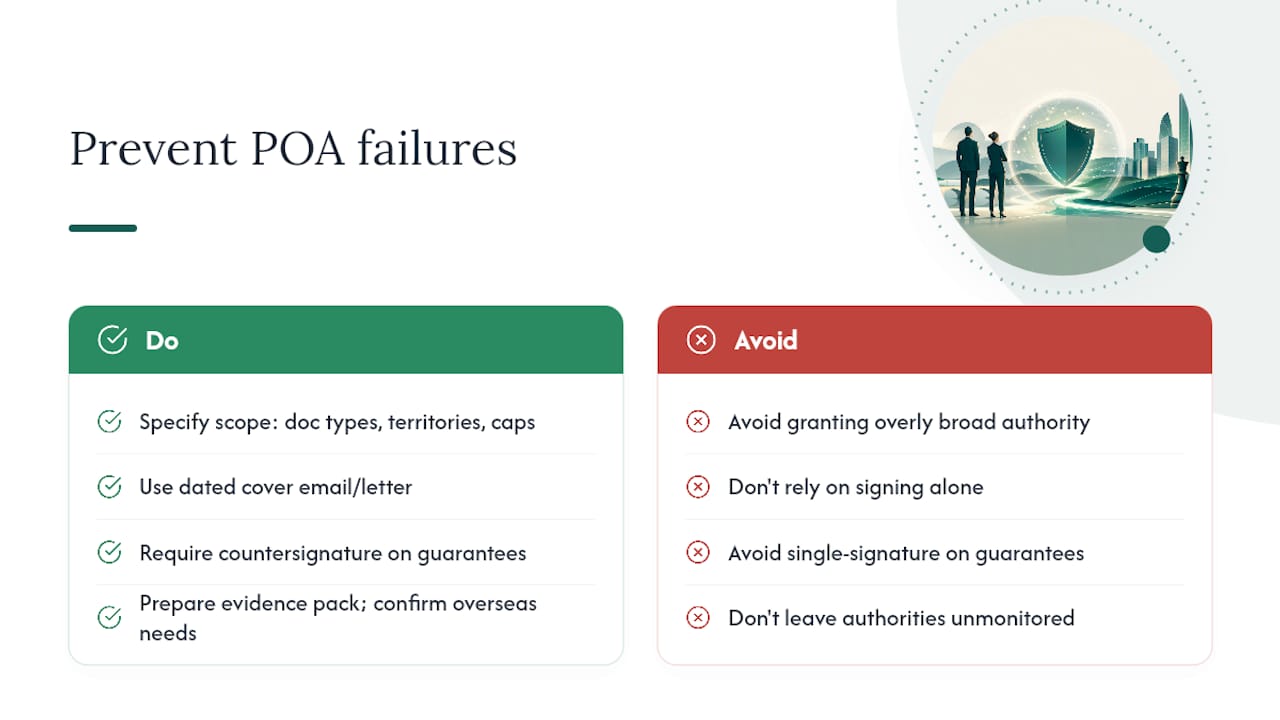
Sub-delegation deserves particular attention. Attorneys appointed by a company cannot sub-delegate the power to execute deeds unless the POA or articles expressly permit it. Free sub-delegation is risky: it extends the company's exposure to persons the board has not vetted. If sub-delegation is needed, restrict it to named individuals and require board consent.
Duration and revocation clauses should be explicit. A fixed end date is cleaner than an open-ended appointment. Include:
- A specific expiry date or a trigger event (completion of the named transaction).
- A clause permitting the board to revoke by written notice at any time.
- A requirement that the attorney return all certified copies on revocation.
- A notice provision specifying how revocation is communicated to third parties.
Pro Tip: Include a countersignature requirement for high-risk documents, such as guarantees or security deeds, so that a second authorised officer must approve before the attorney signs. This single control catches most misuse before it occurs.
Control measures worth including: a quarterly reporting obligation from the attorney to the board, an indemnity clause covering losses from acts outside the defined scope, and a requirement that the attorney notifies the company immediately if the instrument is lost or copied without authorisation.
What board minutes and records should accompany the POA?
Good recordkeeping is not bureaucracy for its own sake. It is the evidence that protects directors if the attorney's authority is later challenged and the proof that counterparties need before they will rely on the instrument.
The board minutes should record the full text of the resolution, the names of directors present and voting, the date and location of the meeting, and any conflicts declared. Where the POA relates to a significant transaction, the minutes should also note the commercial rationale: why a POA was chosen over an alternate director appointment or internal delegation.
Once executed, store the original deed securely and issue certified copies to the attorney and to each counterparty that will rely on it. Counterparties usually require the original or a certified copy of the POA together with the board resolution that authorised it; supplying these proactively avoids delays at closings. Record in the company's authority register: the attorney's name, the scope of authority, the execution date, the expiry date and the names of counterparties who have received copies.
After grant, directors should schedule a periodic review, at least annually, of all active POAs. The review should confirm that the attorney's authority remains appropriate, that reporting obligations are being met and that no revocation trigger has been reached. Where a POA is approaching expiry, decide whether to renew or let it lapse and notify counterparties accordingly.
How do attorneys sign, and how do third parties verify authority?
When an attorney signs on the company's behalf, the signature block should make the representative capacity clear. A typical form reads:
Signed as a deed by [Attorney's Full Name] as attorney for and on behalf of [Company Name] (Registered Number: XXXXXXXX) in the presence of:
The attorney signs on the line above, the witness signs below. Using "as attorney for" in the block is the signal counterparties look for; omitting it can cause a counterparty to treat the signature as the attorney's personal act rather than the company's.
Banks, landlords and commercial counterparties will typically ask for:
- The original POA deed or a certified copy, with the certification signed by a solicitor or commissioned notary.
- The board resolution authorising the grant.
- Proof of the attorney's identity (passport or driving licence).
- Confirmation that the POA has not been revoked (a short letter from the company secretary or a director is usually sufficient).
Where a counterparty is given a copy rather than the original, a short Authority to Act letter on company letterhead, signed by a director, confirming the attorney's appointment and the instrument's current validity, often resolves any hesitation. If a counterparty still refuses to accept a copy, provide a certified copy prepared by a solicitor or commissioned notary, together with a written confirmation of non-revocation. Escalating to the counterparty's legal team with both documents almost always resolves the issue.
Pro Tip: *For banking POAs, contact the bank's legal or compliance team before the transaction closes. Banks have their own internal acceptance criteria, and early engagement avoids a last-minute refusal at the point of signing. My Notary's banking power of attorney service includes certified digital copies formatted to meet standard bank requirements.*
When do you need notarisation and apostille for a company POA used overseas?
Notarisation and apostille are required whenever a company POA will be presented to a foreign land registry, overseas bank, public authority or government body. The requirement is not universal, but it is common enough that assuming you need it is safer than assuming you do not.
Notarisation means a commissioned notary certifies the authenticity of the signatures and the identity of the signatories. The apostille is a certificate attached to the notarised document that confirms the notary's authority is recognised under the Hague Apostille Convention, making the document acceptable in the more than 120 signatory countries. For a Spanish property POA, an Italian banking mandate or a Polish regulatory filing, both steps are typically required. A property POA for use abroad will almost always need this chain.
Three practical options exist:
In-person notarisation. The company's authorised signatories attend a notary's office, sign in the notary's presence, and the notary certifies the execution. The apostille is then obtained through the relevant authority. This route is well-established and accepted by virtually all foreign registries, but it takes time and requires travel.
Remote online notarisation. A commissioned notary conducts the session via secure video call, verifies the signatories' identities using biometric checks, and issues a certified digital copy. This route is faster and removes the need for travel. Acceptance by foreign registries varies: most EU land registries and banks accept remotely notarised documents when the process meets their jurisdiction's requirements, but it is worth confirming with the receiving authority before proceeding.

Apostille procurement. Once notarised, the document is submitted for apostille. Timescales vary; using a specialist service that handles both notarisation and apostille in sequence reduces the risk of errors in the chain.
Pro Tip: Before instructing a notary, contact the receiving authority in the target jurisdiction, whether a Spanish notaría, an Italian conservatoria or a Polish sąd rejonowy, and confirm exactly what format and certification they require. Requirements differ by country and sometimes by region within a country.
For cross-border use, also consider certified translation. Most foreign authorities require the POA to be translated into the local language by a sworn or certified translator, with the translation itself notarised or apostilled. Build translation time into the overall timeline.
Risk note on remote notarisation: identity verification must be robust. Biometric checks and live video confirmation are the standard safeguards. Certified copies issued remotely carry the same legal weight as in-person copies when the process is correctly followed, but some foreign registries have not yet updated their internal guidance to reflect this. Always obtain written confirmation from the receiving authority if there is any doubt.
What do company POAs typically cost and how long does the process take?
Costs and timescales vary depending on complexity, the number of attorneys appointed and whether overseas use requires notarisation and apostille. The figures below reflect typical ranges in the UK market; your solicitor or notary will give you a specific quote.
Common cost items:
- Solicitor drafting fees for a straightforward specific POA: typically in the range of a few hundred pounds, rising significantly for complex or multi-jurisdiction instruments.
- Notarisation fee: charged per document by the commissioned notary; fees vary by notary and document complexity.
- Apostille fee: a fixed government fee per document, payable to the relevant authority.
- Certified copy preparation: usually a modest per-copy charge from the notary or solicitor.
- Courier or secure delivery charges for physical originals sent overseas.
Typical time estimates:
- Board approval and drafting: one to five working days, depending on whether a template is available and how quickly the board can convene.
- Execution and delivery: same day to two working days once the instrument is ready and signatories are available.
- Notarisation: often within one working day for straightforward instruments; remote online notarisation can be completed within hours.
- Apostille: timescales vary; expedited services are available and reduce the wait materially.
- Certified translation: typically two to five working days depending on language and document length.
To speed the process, maintain a pre-approved POA template reviewed by your solicitor, keep an up-to-date list of authorised signatories with their specimen signatures, and notify counterparties of the intended POA early so they can confirm their acceptance requirements before the instrument is executed.
What risks do directors face when delegating authority by POA?
Directors remain personally responsible for the oversight of any authority they delegate. Granting a POA does not transfer fiduciary duty; it extends the company's exposure to a third party's acts. Improper delegation, or failure to monitor an attorney's exercise of authority, can amount to a breach of directors' duties under the Companies Act 2006.
Red flags that should prompt immediate review or revocation:
- The attorney's authority is drafted so broadly that it covers document types or values the board did not specifically consider.
- No countersignature requirement exists for guarantees, security documents or high-value contracts.
- The attorney has not submitted required reports and the board has not followed up.
- There is evidence of sub-delegation to an unvetted individual.
- The instrument has no expiry date and has been in place for more than twelve months without review.
Mitigation checklist for directors:
- Set a monetary cap and document-type restriction in the POA from the outset.
- Require the attorney to report to the board on a defined schedule.
- Maintain an audit trail of documents signed under the POA.
- Confirm that the company's insurance covers acts of the attorney within the defined scope.
- Establish a clear revocation procedure: written notice from the board, immediate retrieval of certified copies, and written notification to all counterparties who hold a copy.
Pro Tip: If you suspect misuse, revoke immediately by written board resolution and notify all counterparties in writing the same day. Do not wait for the attorney to confirm receipt; send notice directly to each counterparty who holds a copy of the instrument.
For complex international delegations, consider engaging a planning specialist. Elite Legacy Planning offers consultation on delegation structures in commercial settings, which can be useful where the authority chain spans multiple jurisdictions.
Step-by-step checklist and essential sample wording
The following checklist covers the full lifecycle of a company POA from need assessment to authority register update.
| Step | Action |
|---|---|
| 1. Assess the need | Confirm a POA is the right tool; identify the attorney, the scope, and the duration required. |
| Review the articles | Check delegation clauses; confirm the board may grant a POA and note any restrictions. |
| 3. Board resolution | Pass and minute the resolution; record rationale, scope, attorney identity and revocation rights. |
| 4. Draft the instrument | Instruct a solicitor to draft or adapt a template; include operative grant, scope, sub-delegation prohibition, duration, revocation and signature block. |
| 5. Execute as a deed | Two authorised signatories, or one director plus independent witness; date and deliver. |
| Notarise and apostille | Where overseas use is required, instruct a commissioned notary and obtain apostille. |
| Prepare evidence pack | Certified copy of deed plus certified copy of board resolution; prepare for each counterparty. |
| Issue and register | Distribute evidence packs; update the authority register with attorney name, scope, expiry and counterparty list. |
| Monitor and review | Schedule periodic review; collect attorney reports; check expiry dates. |
| Revoke when done | Pass revocation resolution; notify counterparties; retrieve copies; update register. |
Sample clause cues for your legal drafter:
Operative grant clause: "The Company hereby appoints [Attorney Full Name] of [Address] as its attorney to execute on its behalf [describe document types] in connection with [describe transaction or purpose] subject to the limits set out in Schedule 1."
Scope description: "The attorney's authority is limited to [document types], in respect of [named counterparties or territory], and does not extend to documents with a value exceeding £[amount] or to any guarantee, indemnity or security document."
Sub-delegation wording: "The attorney may not sub-delegate any power conferred by this instrument without the prior written consent of the board of directors."
Duration and revocation clause: "This power of attorney expires on [date] or on completion of [named transaction], whichever is earlier, and may be revoked at any time by written resolution of the board."
Signature block: "Executed as a deed by [Attorney Full Name] as attorney for and on behalf of [Company Name] (Registered Number: XXXXXXXX) in the presence of: [Witness signature, name and address]."
For the Authority to Act letter, include: the company's name and registered number, the attorney's full name, a reference to the POA deed by date, a confirmation that the POA has not been revoked, and a director's signature with their name and title.
Practical precedents for commercial POAs are available from major legal publishers and provide fuller operative wording that your solicitor can adapt.
When should you seek legal advice and what should you do this week?
Certain situations require a solicitor's input before you proceed. Seek legal advice immediately if:
- The POA relates to real property, whether a transfer, lease or charge.
- The attorney will sign guarantees, indemnities or security documents.
- The transaction is cross-border and involves a foreign land registry, bank or regulatory authority.
- The monetary value of the documents the attorney will sign is material to the company.
- The articles contain bespoke delegation restrictions that are not straightforward to interpret.
- You are unsure whether a previous POA has been validly revoked.
For officers who are confident the situation is straightforward, the practical next steps this week are:
- Pull the company's articles and confirm the delegation clause.
- Schedule a board meeting or written resolution procedure.
- Instruct your solicitor to prepare or review a draft deed and resolution.
- Gather the proposed attorney's identity documents (passport, proof of address).
- Contact key counterparties, particularly banks and land registries, to confirm their acceptance requirements.
Assemble the following documents before the board meeting: the current articles of association, any existing delegation policies or signing authorities, the company's professional indemnity and D&O insurance schedule, and a list of current authorised signatories with specimen signatures. Having these ready shortens the drafting process and reduces the risk of a last-minute governance gap.
For international transactions, consider booking a planning consultation to map the full authorisation chain before the instrument is drafted. Elite Legacy Planning's booking page offers consultations on complex international delegation structures.
A practitioner's perspective on what actually goes wrong
The most common failure in company POA practice is not a legal error. It is a drafting omission that only becomes visible at the worst possible moment: the closing table, the bank's compliance desk, or a foreign registry counter.
Ambiguous scope is the single most frequent problem. Instruments that describe the attorney's authority as "all matters relating to the company's business" or "any documents the company may require" are almost useless in practice. A counterparty's legal team will not accept them, and a court asked to interpret them will do so narrowly. The discipline of specifying document types, territories and monetary caps forces the board to think clearly about what they are actually delegating, which is itself a governance benefit.
Missing delivery language is the second pitfall. Many officers assume that signing the deed is sufficient. It is not. Delivery, the act that confirms the company's intention to be bound, must be evidenced. A dated covering letter or email confirming release of the deed is a simple fix that prevents a later challenge to the instrument's validity.
Inadequate countersignature controls are the third. A POA that allows an attorney to sign guarantees or security documents without a second authorised officer's approval is an open door to significant liability. The countersignature requirement costs nothing to draft and can prevent losses that dwarf the legal fees for the entire transaction.
On working with counterparties: prepare the evidence pack before you need it. Banks and registries do not wait. A certified copy of the deed and the board resolution, ready to send on the day of execution, removes the most common source of completion delays. For overseas transactions, confirm the receiving authority's requirements in writing before instructing the notary, because a notarised document in the wrong format may need to be redone entirely.
The governing principle is simple: grant narrowly, document fully, and maintain a live authority register. A POA that is too broad, poorly evidenced or left unmonitored is not a tool for efficiency. It is a liability waiting to be triggered.
How My Notary simplifies notarisation and certification for company POAs
Executing a company POA is one thing. Getting it certified, apostilled and into the hands of a foreign counterparty quickly is another challenge entirely. My Notary addresses that second step directly.

My Notary connects company officers with commissioned notaries via secure video call, completing identity verification with biometric checks and issuing certified digital copies with an average turnaround of one hour. For a POA that needs to reach a Spanish notaría, an Italian bank or a Polish registry, that speed matters. The platform handles online signature certification, certified copy issuance and apostille procurement in sequence, removing the coordination burden from your team. Corporate document notarisation is available for the full range of company instruments, including POAs, board resolutions and certified copies of constitutional documents. Electronic signatures issued through My Notary are recognised in over 180 countries, which covers the vast majority of jurisdictions where a UK company is likely to need a POA accepted. To get started, upload your executed POA deed and book a video session with a commissioned notary directly on the My Notary platform.
Sources
- Powers of attorney in commercial transactions | LexisNexis
- Company power of attorney | LegalVision UK
This article is general information, not a substitute for advice from a qualified lawyer. Consult a qualified legal professional about your own circumstances before acting on anything here.
FAQ
What are the main types of power of attorney a company can grant?
A company can grant a general POA covering a broad range of acts, a specific (transaction-limited) POA restricted to named documents or a defined transaction, or a joint or joint-and-several appointment where two attorneys are named. The specific form is the most common in commercial practice because it limits the company's exposure and gives counterparties a clear picture of the attorney's authority.
How much does it cost to put a company POA in place?
Solicitor drafting fees for a straightforward specific POA typically run to a few hundred pounds; complex or multi-jurisdiction instruments cost more. Notarisation, apostille and certified copy fees are charged separately and vary by notary and document. Remote online notarisation through a platform such as My Notary can reduce the overall cost and time compared with in-person alternatives.
How do counterparties know whether a company POA is valid?
Counterparties verify authority by requesting the original or a certified copy of the POA deed together with the board resolution that authorised it. A short confirmation letter from the company secretary or a director, confirming the instrument has not been revoked, is also commonly required. Banks and registries may carry out additional checks on the attorney's identity.
Can a company create a business lasting power of attorney?
A Lasting Power of Attorney is a personal statutory instrument registered with the Office of the Public Guardian; it is not available to companies. A company that needs to plan for director unavailability uses a corporate POA executed as a deed, supported by a board resolution, rather than an LPA. The two instruments serve different purposes and operate under different legal frameworks.
Does a company POA need to be notarised for use in the UK?
Notarisation is not a legal requirement for a company POA used purely within the UK, though some counterparties, particularly banks, may request a certified copy prepared by a solicitor or commissioned notary. For overseas use, including a Spanish property POA, an Italian banking mandate or a Polish regulatory filing, notarisation and an apostille are typically required by the receiving authority.
Recommended
Got questions? We’re on it.
Most questions are answered here, drawn from what people actually ask before booking. If yours isn’t, our team is in chat.
A company can grant a general POA covering a broad range of acts, a specific (transaction-limited) POA restricted to named documents or a defined transaction, or a joint or joint-and-several appointment where two attorneys are named. The specific form is the most common in commercial practice because it limits the company's exposure and gives counterparties a clear picture of the attorney's authority.
Last updated: